The question “Which is better, Kevlar or carbon fibre?” is not really fair. The best way to avoid making a costly mistake when choosing materials is not to give a direct answer to this question. The best material for the job depends on what the material needs to do. Carbon fibre is better at making things stiff, keeping their shape, and withstanding compression. Kevlar® is better at resisting impacts, being strong and absorbing energy.
Key Takeaways
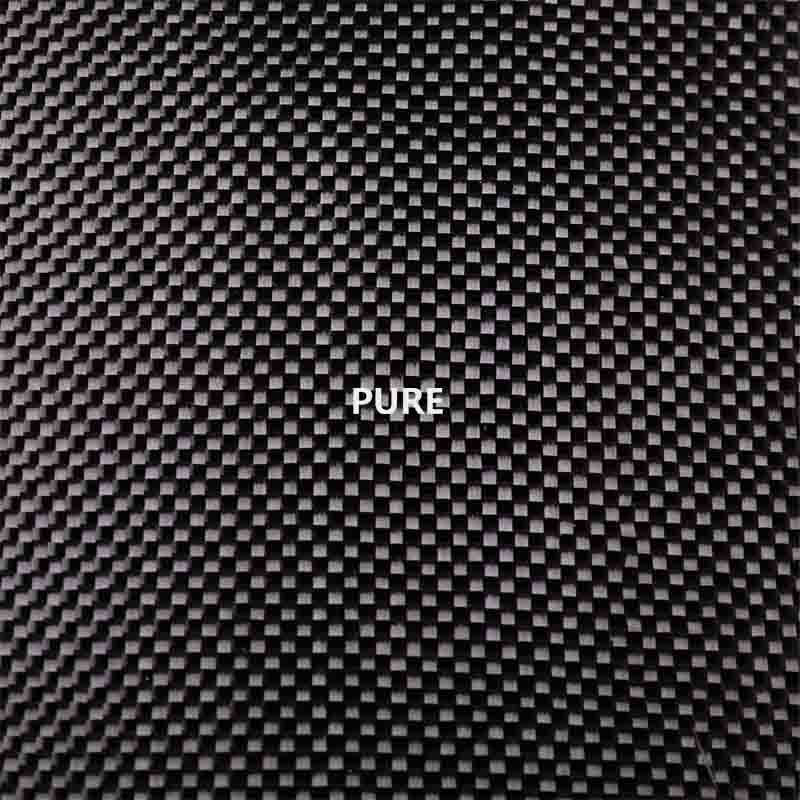
What is carbon fiber? Carbon fiber is a kind of inorganic polymer material with a carbon content greater than 90%. It is produced from organic matrix materials like polyacrylonitrile (PAN), pitch, and viscose by high-temperature carbonization between 1000-3000℃. Although carbon fiber itself has high strength, it is actually quite brittle and is rarely used directly.
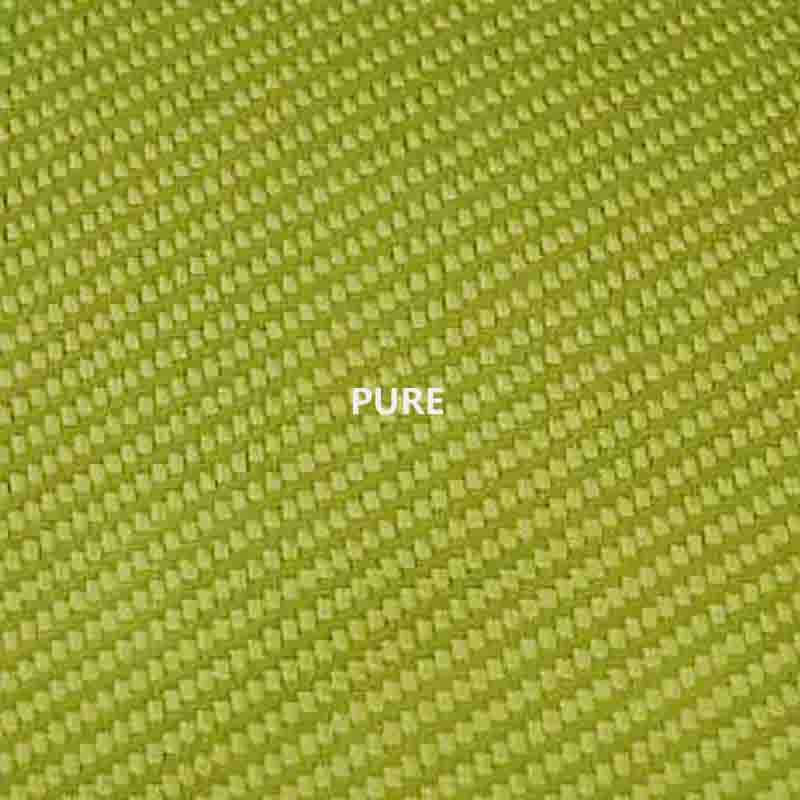
Kevlar® is a special type of fibre made by DuPont Corporation. It is made of long, thin strands that are very strong and do not break easily. Its chemical makeup makes it strong, tough, lightweight, and it can resist cutting and burning. Unlike other thermoplastic fibres, it won’t melt or drip.
Kevlar® is included in the wide class of aramid fibers, but when it comes to aramid fiber vs Kevlar, it is not a comparison between different kinds of fibers.“Aramid” is the name for a category of fibers, whereas “Kevlar®” is the brand name for particular para-aramid fibers. There are various grades of Kevlar® used in different applications.
Kevlar vs carbon fiber differs mainly in stiffness, impact resistance, compression performance, electrical conductivity, and environmental stability. Carbon fiber is the better choice for rigid structures that must resist deformation, while Kevlar® is more suitable for components exposed to impact, abrasion, vibration, or sudden loading. Neither material is universally stronger because the final choice depends on the direction and type of load.
|
Performance Dimension |
Kevlar® |
Carbon Fiber |
Key Decision Factor |
|
Tensile Strength |
3.0–3.6 GPa |
3.5–6.0 GPa |
Pure tensile load → Carbon fiber is superior |
|
Elastic Modulus (Stiffness) |
60–120 GPa |
200–800 GPa |
High stiffness requirements → Carbon fiber is necessary |
|
Compressive Strength |
Approximately 20%–30% of tensile strength |
High |
Compression-dominated structures → Choose carbon fiber |
|
Impact Resistance / Energy Absorption |
High (Elongation: 2.5%–4%) |
Low (Approx. 1.5%) |
Repeated or sudden impact → Kevlar® performs better |
|
Density |
1.44 g/cm³ |
Approx. 1.60 g/cm³ |
Same stiffness target → Carbon fiber structures can be lighter |
|
UV Resistance |
Poor without coating |
Excellent |
Long-term outdoor exposure → Carbon fiber is preferred |
|
Electrical Conductivity |
Non-conductive |
Conductive |
Radar protection / EMI-sensitive equipment → Kevlar® is preferred |
|
Machinability |
Difficult, prone to fraying |
Moderate, more stable |
High precision applications → Carbon fiber is more reliable |
|
Raw Material Cost |
USD 15–25/kg |
USD 10–20/kg |
Most standard grades → Kevlar® composite cost is higher |
Strength figures should be interpreted at three different levels: individual fiber, impregnated lamina, and finished component. Quoting a high fiber tensile strength does not prove that a component will achieve the same result.
Voids, poor fiber wet-out, incorrect orientation, wrinkles, weak interfaces, unsuitable resin, temperature, moisture, and edge damage can all reduce actual performance.
The tensile performance of Kevlar fibre and carbon fibre varies by grade, but high-strength carbon grades in general reach higher ultimate tensile values.
Carbon fibre has been demonstrated to have particular efficacy when its continuous filaments are aligned with a predictable tensile load. Kevlar continues to demonstrate a high level of competitiveness in terms of its strength-to-weight ratio, and it exhibits superior strain tolerance before failure.
Stiffness is the resistance of a component to deformation, while Young’s modulus describes the material’s stress-to-strain relationship in its elastic region.
Carbon fiber has a clear advantage in modulus. Standard-modulus carbon fiber is commonly around 230 GPa, intermediate-modulus products around 290 GPa, and specialized high-modulus grades can be significantly higher.
Kevlar’s modulus is lower, so a Kevlar laminate may deflect more under the same geometry and loading. This additional flexibility is helpful in impact absorption but unsuitable when tight dimensional tolerances or minimal bending are essential.
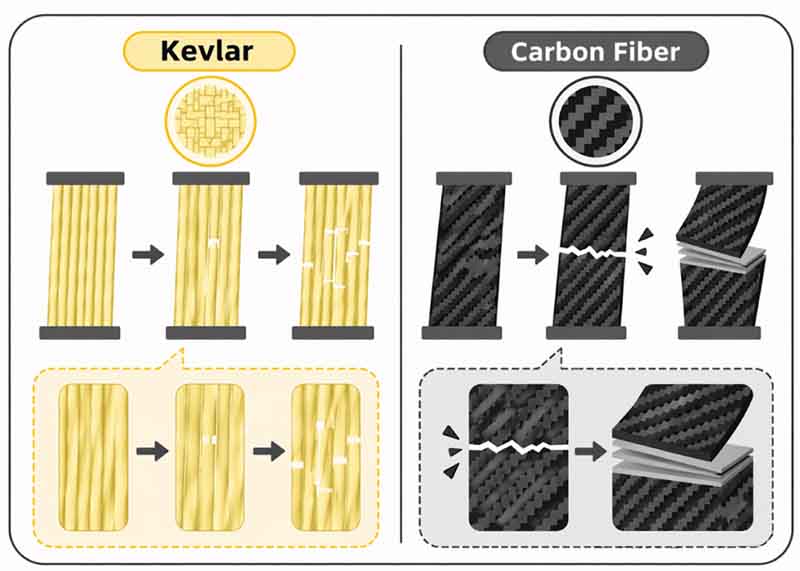
Kevlar normally has greater elongation at failure and absorbs more energy before rupture. Carbon is less tolerant of local impact and tends to fail in a more brittle manner. Carbon damage can also remain hidden below the laminate surface, making inspection important after impact.
Carbon fiber vs Kevlar under impact loading shows the clearest practical difference between the two reinforcement families. Kevlar’s higher failure strain, toughness, and fibrillar structure allow it to deform and dissipate impact energy over a wider area. Carbon fiber provides excellent axial strength and stiffness but has lower strain capacity, so local impact can cause fiber fracture, matrix cracking, or delamination.
Carbon Fiber
Carbon laminates can withstand significant loads when designed correctly, but sudden transverse impact is a common concern.
The visible surface mark may appear minor even when internal delamination has reduced residual compression strength.
In the domains of aerospace, automotive, pressure-vessel, and high-performance sporting applications, post-impact inspection may necessitate the implementation of various methodologies, including tap testing, ultrasonic inspection, thermography, or other validated approaches.
The hypothesis that carbon fibre is unsuitable for impact environments must be tested rigorously to be substantiated.
The utilisation of toughened resin systems, woven architectures, thicker laminates, protective outer layers, and hybrid reinforcement has been demonstrated to enhance damage tolerance.
According to the findings of NASA research, the performance of impact is contingent on the architecture of the laminate and the through-thickness reinforcement, as opposed to the fibre identity in isolation.
Kevlar
Kevlar can stretch and distribute impact energy while helping prevent fragments from separating. This explains its use in ballistic systems, protective panels, helmets, boat hulls, and impact-resistant enclosures. However, excellent tensile impact behavior does not eliminate its weaknesses in compression, moisture management, edge finishing, and resin adhesion.
In a carbon fiber kevlar hybrid, carbon layers can provide stiffness while Kevlar layers improve damage retention. The stacking order matters: placing Kevlar near an impact-facing or rear surface can produce different results from distributing it uniformly throughout the laminate. Prototype testing should reproduce the real impact energy, support conditions, temperature, humidity, and number of repeated impacts.
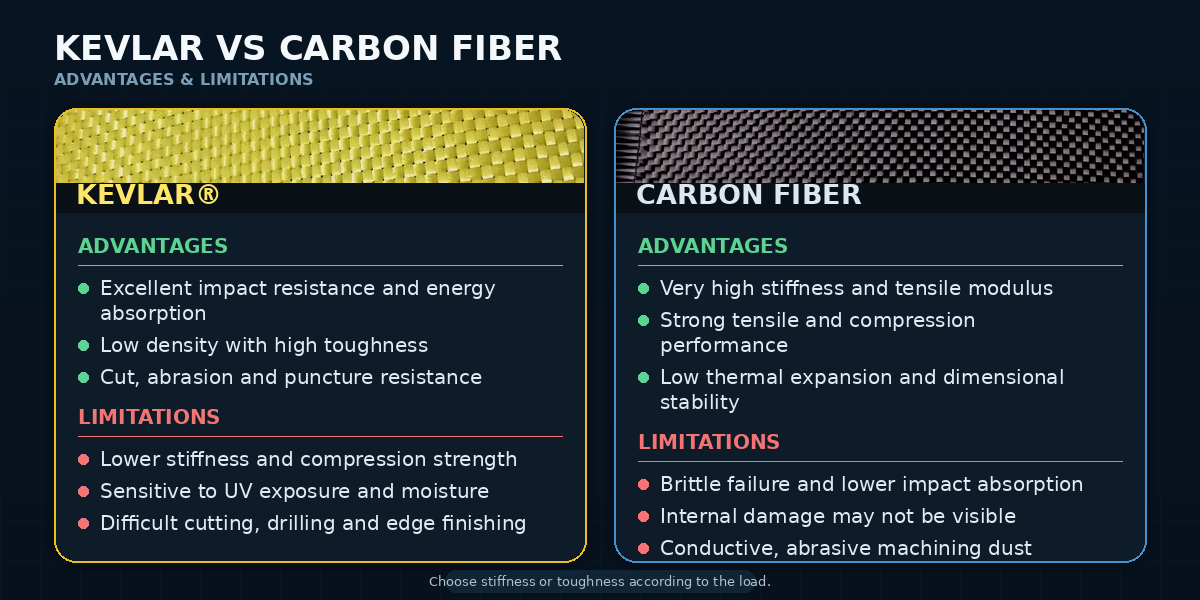
The choice between Kevlar and carbon fiber essentially depends on which failure mode your product needs to resist: preventing stiffness loss under sustained structural loads, or avoiding catastrophic fracture under sudden impact.
Carbon Fiber Advantages
Carbon Fiber Limitations
Kevlar Advantages
Kevlar Limitations
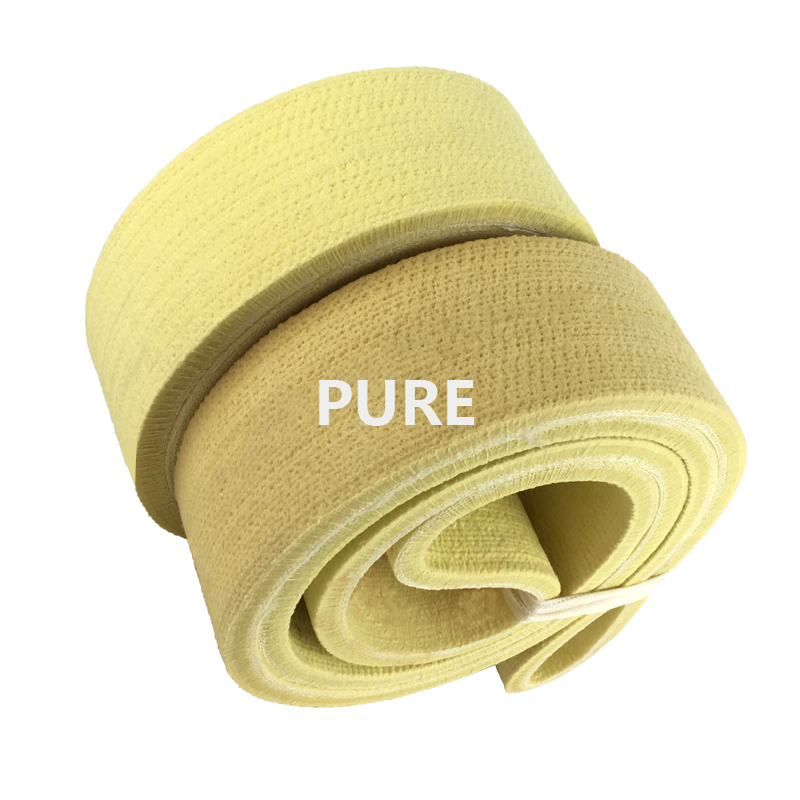
Kevlar® is one of the earliest high-strength synthetic fibres to gain recognition in the fibre-reinforced plastics (FRP) industry.
The material known as composite-grade Kevlar® is notable for its low density and excellent specific tensile strength. It is frequently extolled for its considerable resistance to both impact and abrasion.
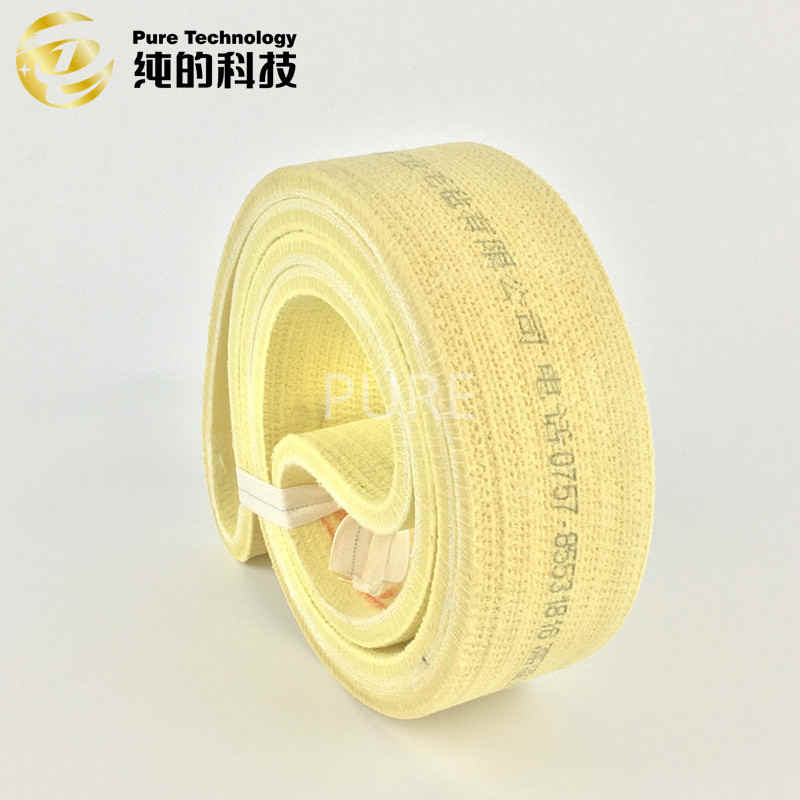
The material under discussion is employed in a variety of common applications, including, but not limited to, lightweight hulls such as kayaks and Kevlar belts, aircraft fuselage panels, and pressure vessels. The utilisation of Kevlar® is most effective when combined with epoxy or vinyl ester resins.
Kevlar® can be difficult to cut, sand, and machine, and is not suitable for applications requiring compressive strength.
Graphite fibers contain up to 95% carbon and have the highest ultimate tensile strength in the FRP industry. This is the force required to pull both ends of any length to break.
In fact, they also possess the highest compressive strength and flexural or bending strength in the industry. After processing, these fibers are combined to form carbon fiber-reinforced materials such as fabrics, tows, and sleeves.
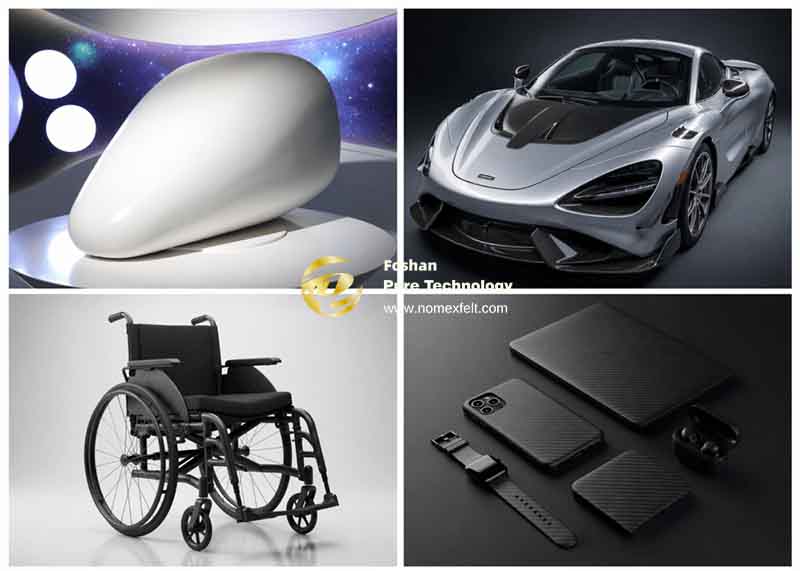
These reinforcements offer the highest weight strength and stiffness in the industry—more than any other common reinforcement material and even most traditional building materials. Carbon fiber also provides ideal black cosmetics.
The following three questions can replace vague discussions like “Which is better, Kevlar or carbon fiber?” and help you make clearer engineering decisions.
Please answer them in order.
1. What failure mode does your component primarily need to resist? If it’s compressive load or continuous structural stiffness requirements, choose carbon fiber.
If it’s sudden or repeated impact and you need to avoid catastrophic fracture, choose Kevlar. If both are present, consider a hybrid laminate design.
2. Does the product’s surface appearance have functional or brand value? If so, choose carbon fiber.
Kevlar’s woven texture and natural yellow color are not suitable for the surface specifications of Class A automotive exterior parts or high-end consumer products. If not, proceed to the third question.
3. Are there electromagnetic interference susceptibility or long-term outdoor UV exposure requirements? If it’s an electromagnetically sensitive enclosure or radome, choose Kevlar because it’s non-conductive. If there’s long-term outdoor exposure and you don’t want an additional protective coating, choose carbon fiber because carbon fiber itself has good UV stability.
If the answers to these three questions point in different directions, the correct solution is usually not a compromise between the two materials, but rather designing a hybrid composite laminate. At this point, the supplier’s layup engineering capabilities and material characterization processes are more important than the material itself.
Is Kevlar stronger than carbon fiber?
In terms of elastic modulus, or stiffness, carbon fiber is two to six times stronger than Kevlar. However, in terms of impact energy absorption and fracture toughness, Kevlar is significantly superior to carbon fiber. No single material is absolutely stronger in all dimensions.
Can Kevlar and carbon fiber be used in the same component?
Yes. Hybrid laminates are a well-established engineering solution. The carbon fiber outer layer provides stiffness and surface quality, while the Kevlar inner layer prevents crack propagation after impact.
Which is actually more expensive, Kevlar or carbon fiber?
Kevlar precursor is more expensive, costing approximately $15–25 per pound, while standard carbon fiber costs approximately $10–20 per pound. When total manufacturing costs are factored in, including processing labor, scrap rates, and mold complexity, carbon fiber generally offers a cost advantage in large-scale production because its processing routes are more easily automated and its quality control systems are more mature.
What are the main disadvantages of Kevlar in structural applications?
Three limitations are critical in engineering. First, its compressive strength drops to approximately 20%–30% of its tensile strength, making Kevlar unsuitable as the primary reinforcement material in structures primarily subjected to compressive loads. Second, without a protective coating, UV exposure gradually reduces its tensile properties. Third, processing quality is difficult to control; CNC cutting is prone to burrs, and hole geometry is unstable, increasing post-processing costs per piece in large-scale production.
As we know, Heat Transfer Printing Felt is suitable for fabrics, decorative fabrics, curtains, le...

Read Safety Rules for Laundry Management to be a qualified manager. PARTⅠ Laundry room Safety Gen...
The aluminum extrusion machine is the leading equipment for the production of aluminum profiles. ...
Heat transfer printing is a contemporary printing process in the clothing market. It prints the p...
In the textile industry, felt is only a small part but important. About how to choose felt that i...
Foshan Pure Technology Company., Ltd. helps conveyor belt manufacturers source equipment to metal...
What is Nomex? Meta-amide, or meta-phenylene isophthalamide, is made from meta-phenylenediamine a...
Kevlar Fiber Introduction In the development of materials science, Kevlar fiber has particularly ...